

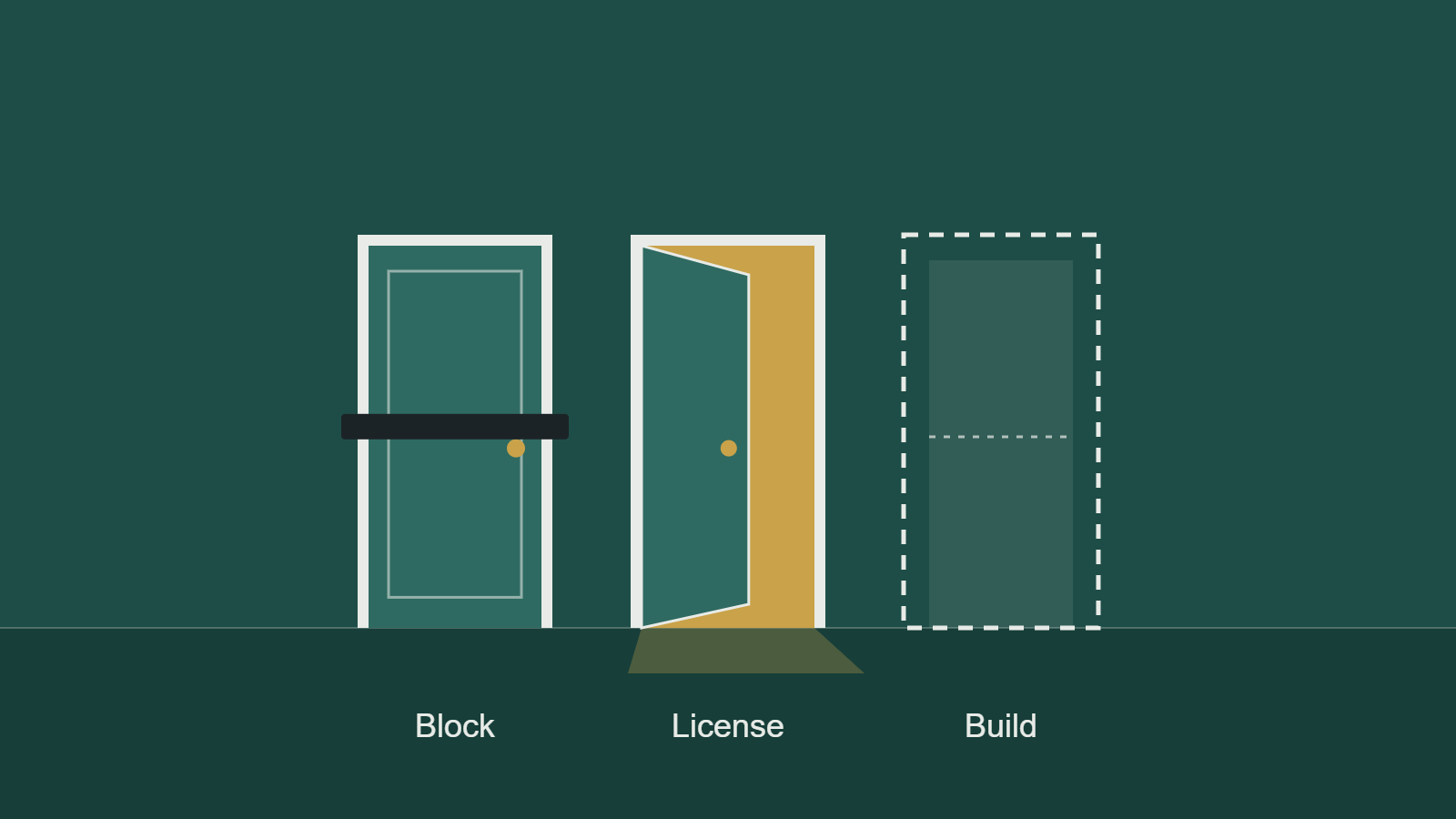
For two years, AI agents shopping on a customer’s behalf lived in strategy decks. In September they became a product. Meta’s Muse reached the top of Apple’s free app chart ten days after launch and can book, buy and check out across the web. Three weeks later OpenAI launched Dots. Most coverage asks whether consumers will trust these agents. I think the businesses on the other end have more at stake, and many of them are still waiting to see where the market goes.
Waiting is now a decision too. The companies that are blocking or partnering on purpose are learning how this works. The ones waiting will be drawn into a game whose rules they did not write.
What changed
Agents that act for shoppers are not a new idea. What changed in the last few weeks is that three conditions arrived at once.
Agents stopped asking permission. OpenAI’s in-chat checkout, launched in September 2025, only covered merchants that signed up and integrated, so a business could ignore it. Muse works differently. Where a service has no official connection, Meta says the agent can use it through a browser the way you would. Your business is in the game whether or not you joined, which is why Amazon had to block Muse to stay out.
Distribution arrived. These agents now ship inside products people already use every day. Muse works inside WhatsApp and is free to start. Dots lives inside ChatGPT, which OpenAI says has 900 million weekly users.
Money and markets moved. Mark Zuckerberg has said Meta will take a small fee on Muse transactions. Once Muse showed it could book travel, investors sold off travel stocks within days. Businesses started taking public positions, some blocking and some signing on.
None of this means agents have already won. When Walmart sold through ChatGPT’s in-chat checkout, purchases converted at about a third of the rate of its own site, Walmart told Wired. The threat is real, the rules are still being written, and that is the opening.
Why big tech is pushing
Free chat is hard to make money from. OpenAI reported about 50 million paying subscribers against 900 million weekly users, so roughly one user in eighteen pays. An agent that books or buys creates a transaction, and a transaction can carry a fee. OpenAI’s first attempt stalled and it pulled back to product discovery. Meta is now trying again at a larger scale.
For big tech, this is the first consumer AI model that can earn from every user. For many of the businesses those users buy from, the incentives run the other way.
Attention versus value
My read is that the impact splits along one line.
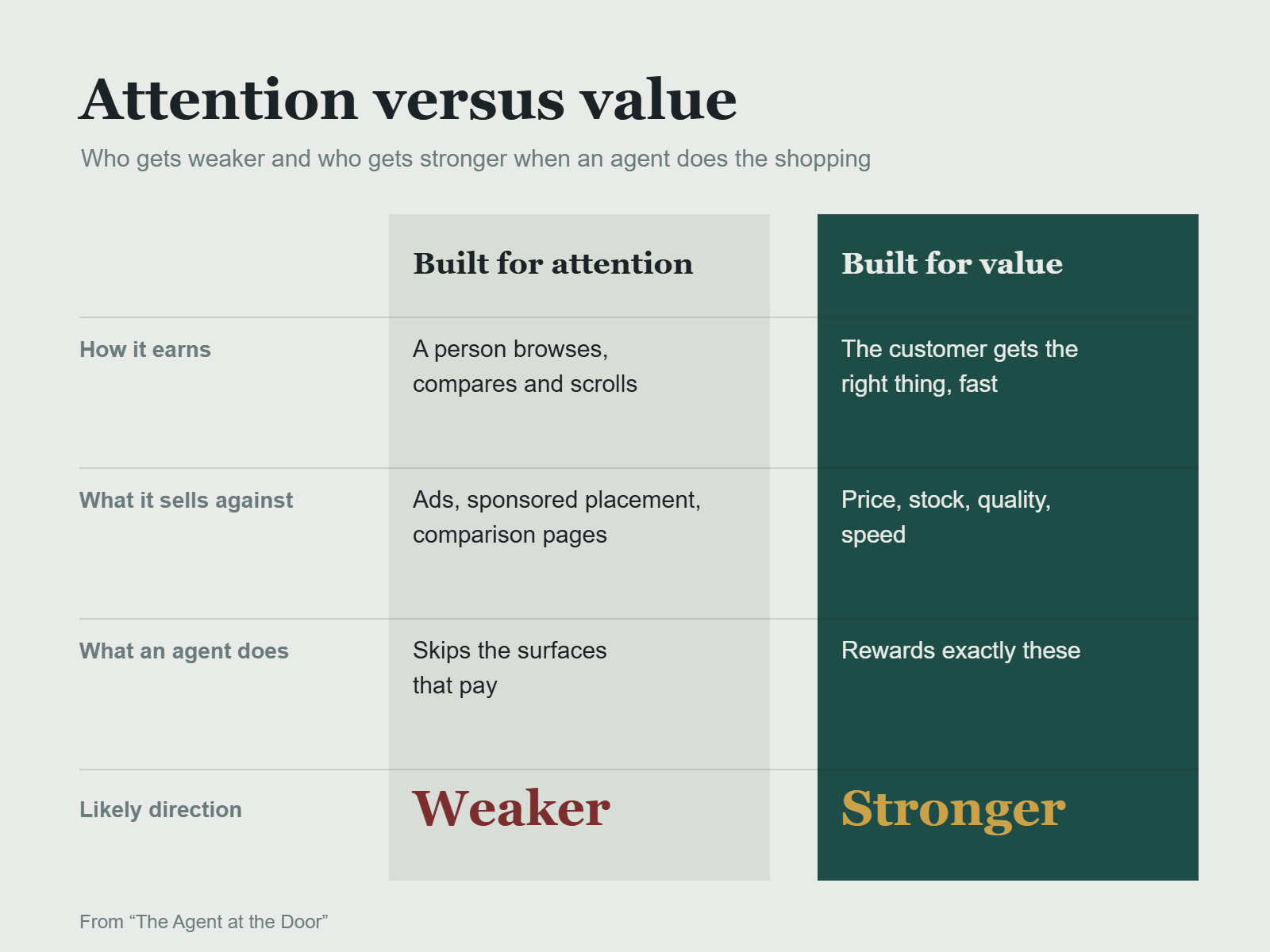
An agent goes to the item, compares on what it was told to care about, and leaves. When OpenAI launched shopping in ChatGPT, it said it ranked merchants on availability, price, quality and whether the merchant is the primary seller. Placement and persuasion were not on the list. Arun Sundaram of CFRA said businesses that depend on consumer inertia, meaning customers who buy out of habit, are the most exposed when agents make comparing easy.
Many companies sit on both sides of this picture. Amazon is one of the strongest value businesses in the world and also runs a large advertising business. For companies like that, the split runs through the middle of the company.
What an agent needs, and the three doors
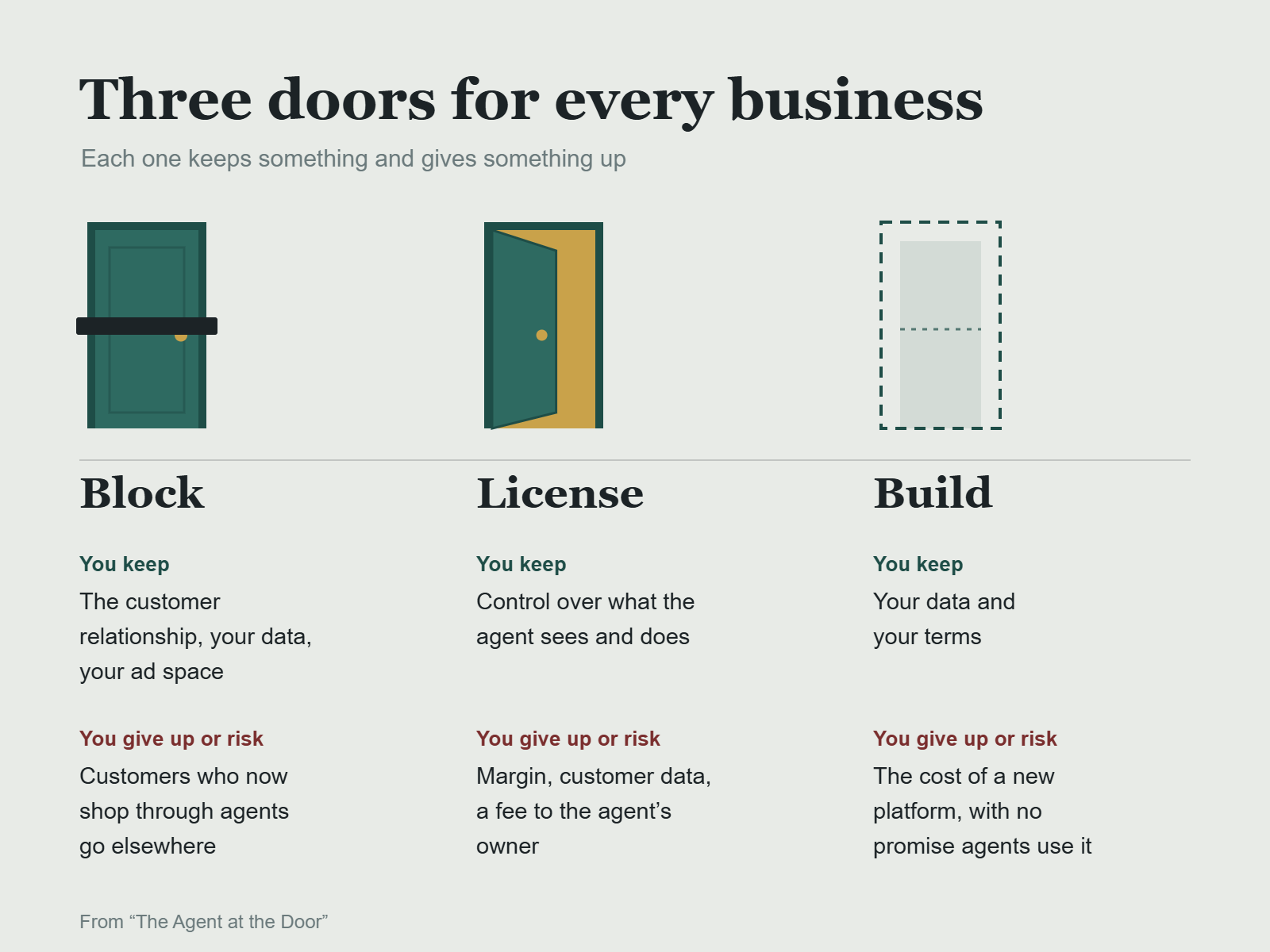
To finish a job, an agent needs three things from a business. It needs a way in, through an official connection or a browser using the customer’s password. It needs a name tag, so the business knows it is an agent and whose agent it is. And it needs a wallet the store accepts. Every choice a business makes comes down to which of these it grants, to which agents, on what terms.
Who is writing the rules
Four companies show what being in the game looks like.
Amazon blocked on purpose. It asked Meta to leave Amazon out of Muse, then blocked the agent. It gave three reasons: Meta never told Amazon that Muse would shop there, the agent does not identify itself, and it appears to capture and store customer credentials. Analysts also pointed to a business reason, since an agent that clicks buy skips the browsing that retail ads are sold against. Amazon did not partner, but its demand that agents identify themselves could become a standard others follow.
Shopify opened the door for its merchants. On September 21, the day after Amazon’s block, Shopify CEO Tobi Lütke announced a partnership with Muse for agentic checkout with Shop Pay on all Shopify stores. It is the opposite of what Amazon objected to. The agent finds products through Shopify’s catalog and pays through Shop Pay, without logging in as the customer. Shopify’s shares rose about 7% that day and again the next. There is a catch for its merchants. Shopify had already added Meta as an AI channel on September 8, the day Muse launched, with product sharing and direct checkout on by default for eligible stores. Switching off catalog access does not stop a store’s public pages from being crawled. Many merchants entered this game through a decision their platform made for them.
Walmart played and learned. It sold through ChatGPT’s checkout and measured the result: a third of its own site’s conversion rate. OpenAI later let merchants keep their own checkout. My read is that data from players like Walmart helped change those rules. Walmart is now a Muse partner, though NBC News found its site still blocking Muse in tests, so even players are still working it out.
Expedia joined and paid for it. It announced its Muse partnership on September 22, and its shares fell about 7% the next day. Being in the game is no guarantee. But Expedia is learning on live traffic while its competitors guess.
None of these four has this figured out. All four are learning, and their choices are shaping the terms everyone else will get.
Where this is heading
This part is my own synthesis. If some businesses open the door and others close it, agents will route around the closed ones, and what an agent can reach becomes what its user sees. The largest destinations can afford to block, because people will still come to them directly. The smallest cannot afford to stay out, and Meta is already courting them with Muse for Small Business. The middle is squeezed. If it blocks, it risks becoming invisible. If it joins, it risks becoming an interchangeable supplier in someone else’s checkout.
Agents are also starting to deal with each other. Instinct already lets one person’s agent coordinate plans with a friend’s. A business with no door for agents may soon be missing from conversations it never knew were happening.
Why waiting loses
Waiting usually feels safe when a market is unclear. Here it is not, because the agent does not wait. It arrives through a browser on a customer’s password, or through a platform you sell on, whether or not you decided anything.
My view is simple. If agents are not on your roadmap for this year, you are already late. You do not need a finished strategy to start. You need someone accountable and a first decision on the table this quarter. Every month you wait, other companies are setting the terms you will inherit.
Four moves to start with:
Name an owner. The agent decision is a security, legal, commercial and platform call at once. Left alone, it gets owned by whichever team acts first.
Get in on purpose. Pick a door for each agent, check what your platforms have already switched on for you, and run one live test with real customers, the way Walmart did.
Compete on what agents measure. Make your price, availability, product data and policies accurate and machine-readable.
Require a name tag. Ask agents to identify themselves and whose they are. Treat one that will not as any unknown bot.
The businesses blocking or partnering on purpose are writing the rules of this market. The ones waiting will play by them.
If your company is working through this decision, reply to this email. I read every reply, and the hardest questions shape what I write next.