

For the past year, as AI agents have taken on more of the work people used to do on screens, one debate has run through product teams: should software go headless for agents, or keep investing in the experience for people? The headless camp has strong voices. Jakob Nielsen, who co-founded the Nielsen Norman Group and is one of the best-known names in usability, wrote in early 2025 that AI agents would make traditional UI design obsolete. Salesforce opened its whole platform to agents this year with Headless 360, and a16z asked whether software is losing its head. The other camp says the screen still matters. PostHog, an analytics company that agents call millions of times a month, argues that the screen is where people catch what the agent got wrong, and that the future is a mix of both.
Most of this debate skips what is actually deciding the outcome. Agents can already work both ways. They can call your API, or click through your screens like a person, and they will take whichever path gets the job done faster and more reliably. For a product leader, the useful thing to know is which parts of the product need a person at all.
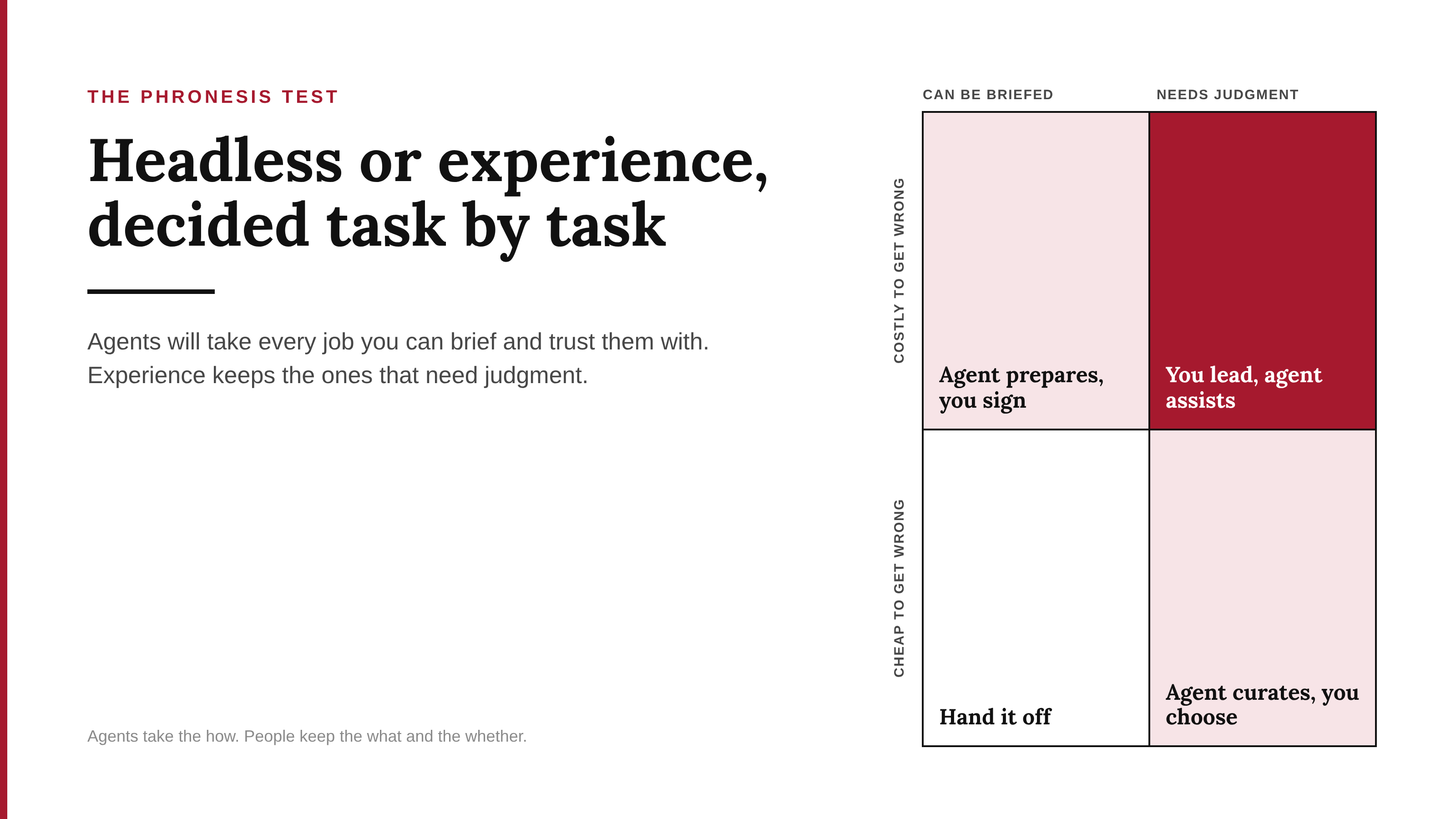
My answer is that experience keeps mattering, but only where judgment lives. Agents will take every job that can be written as a brief and trusted to them. What they cannot take is the part that needs a person to decide, either because the need can’t be put into words or because getting it wrong costs too much.
I call this the Phronesis Test, after an old word for exactly this kind of judgment.
The how, the what and the whether
Aristotle separated two kinds of knowing. Techne is skill that follows a method. It can be taught, written down and repeated. Phronesis (pronounced fro-NEE-sis), usually translated as practical wisdom, is judgment about what to do in a particular situation, and whether to act at all. He thought it came from experience rather than rules.
That split maps closely onto agents and people. Agents are getting very good at techne, the how. Phronesis is the what and the whether, and that is where people stay. People decide what they want, and they decide whether to go ahead.
The test asks two questions of any task in your product.
Can the person write the brief? A simple check: if two people handed the same brief would accept the same result, it can be briefed. “The cheapest flight that lands before noon” passes. “A dress for a friend’s wedding” does not.
What does a wrong call cost, and can it be undone? If a mistake is expensive, hard to reverse or something a person will be held accountable for, that person needs to see the result and sign.
Put those together and you get four kinds of work, each needing a different design.
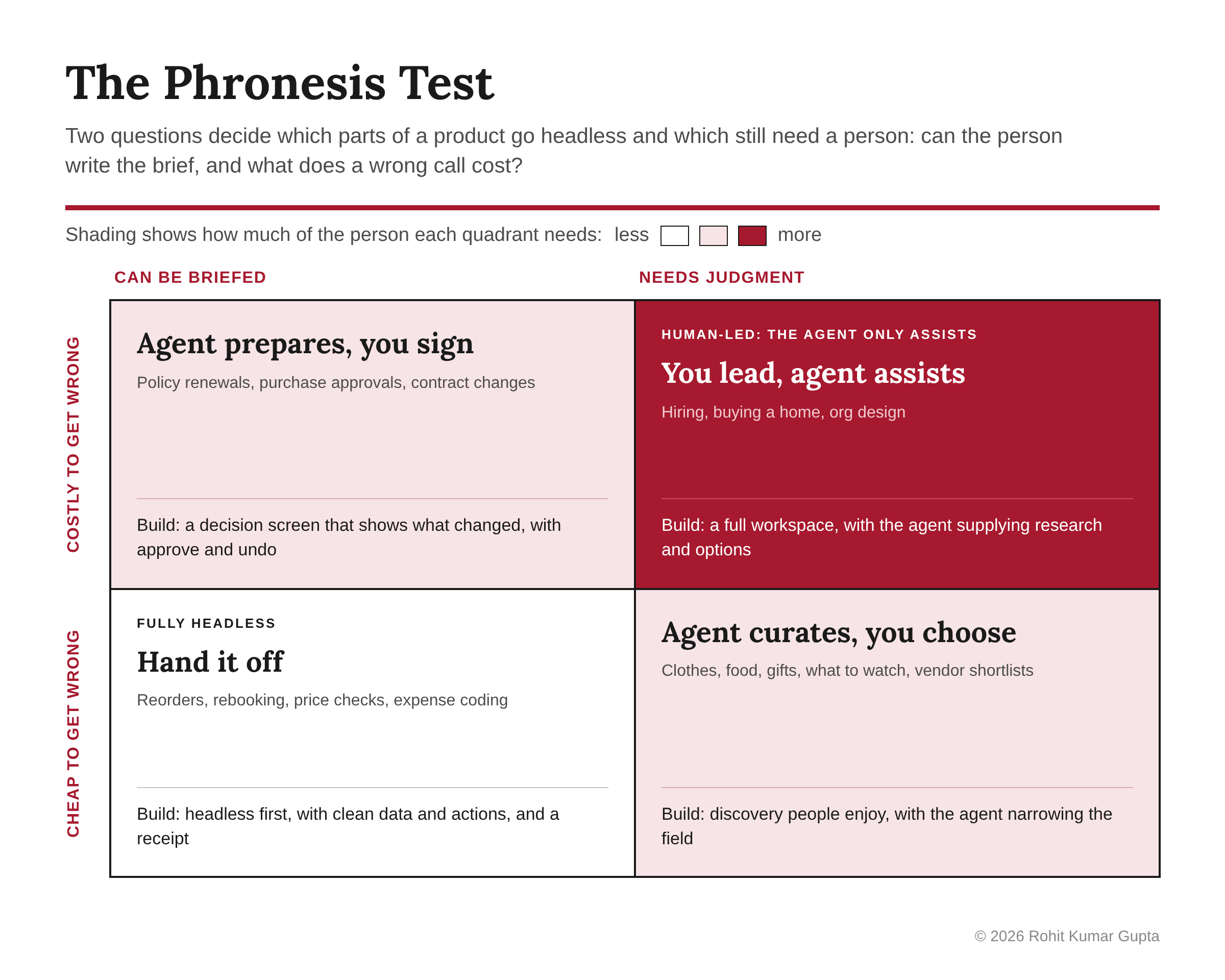
Only one quadrant goes fully headless. The other three still need an interface, and each needs a different one. Yet many products still serve all four with a single experience.
Trust is the gate
Being briefable is necessary, but it is not enough. A task goes headless only once people trust the agent with it.
A University of St. Gallen survey of nearly 3,000 people in Switzerland, Germany and Austria found that only just over one in five trusted AI agents to search, filter and compare products reliably. Wrong purchases and data protection were the biggest worries. In March, OpenAI scaled back its checkout inside ChatGPT after weak uptake and put more weight on helping people discover products. Paying for something you have already chosen is about as briefable as shopping gets. Whatever the full reasons, it shows that a task can be easy to describe and still not be handed over.
So until trust is earned, even the bottom-left quadrant keeps a confirm step and a receipt. The interface there is small, but it is still there.
Agents will take the easier path
The headless argument is right about one thing: agents do not need your screens. PostHog logged close to 10 million agent tool calls into its product in a single month this summer. It also noted that agents mostly work through APIs and tool calls, and that agents which click around a web page like a person are slow.
That gap is where the business risk sits. If your product has no clean way in for an agent, the agent will still get in through your interface. It will be slower, more likely to fail and more expensive for whoever runs it. Today, with agent traffic still a small share for most products, that hardly shows. As agents become the default way people get chores done, I expect they will quietly route toward the products that are fastest and most reliable to work with. It will look a lot like search a generation ago. Sites that crawlers could not read simply stopped showing up.
That is my inference, not a documented trend. The commercial picture is also messier than pure efficiency. Last year Amazon demanded that Perplexity stop its AI browser agent from shopping on Amazon’s store, and Cloudflare is pushing a model where sites charge bots for access. Whether agents get in easily is partly a business decision. But the direction holds. For any task that can be briefed and trusted, being hard for an agent to use is a cost you will pay later.
Where judgment lives
The case for experience rests on research that has been sitting in marketing journals for years. These studies looked at whose advice people accept rather than what they delegate, but they point the same way.
In 2019, Noah Castelo, Maarten Bos and Donald Lehmann showed that people trust algorithms for objective tasks, like financial advice, and resist them for subjective ones, like dating advice. In 2020, Chiara Longoni and Luca Cian found a similar split across more than 3,000 participants. People preferred AI recommendations when practical qualities mattered and human ones when the experience mattered. When AI assisted a person rather than replacing one, people accepted it. The authors also noted that the belief behind the split, that AI is weaker at experiential choices, does not always hold up. It is a perception, and perceptions shift.
This year’s behavior lines up. In the St. Gallen survey, almost half would let an agent compare prices or hunt for deals, but only one in twenty would trust it with the whole purchase. About half said shopping is enjoyable and should not be fully automated. Electronics, which compare on clear specs, was the category people were most willing to automate. Clothing, food and cosmetics were the ones they wanted to choose themselves.
People hand over the brief. They keep the judgment.
The line moves
There are two honest objections to this argument, and both make it sharper.
The first is that taste can be predicted. TikTok and Spotify have done it well for years. That is true, and it is why the Phronesis Test asks whether the need can be briefed rather than whether it involves taste. A recommendation is an agent narrowing the field. The act of choosing is still the person’s, and often it is the part they enjoy.
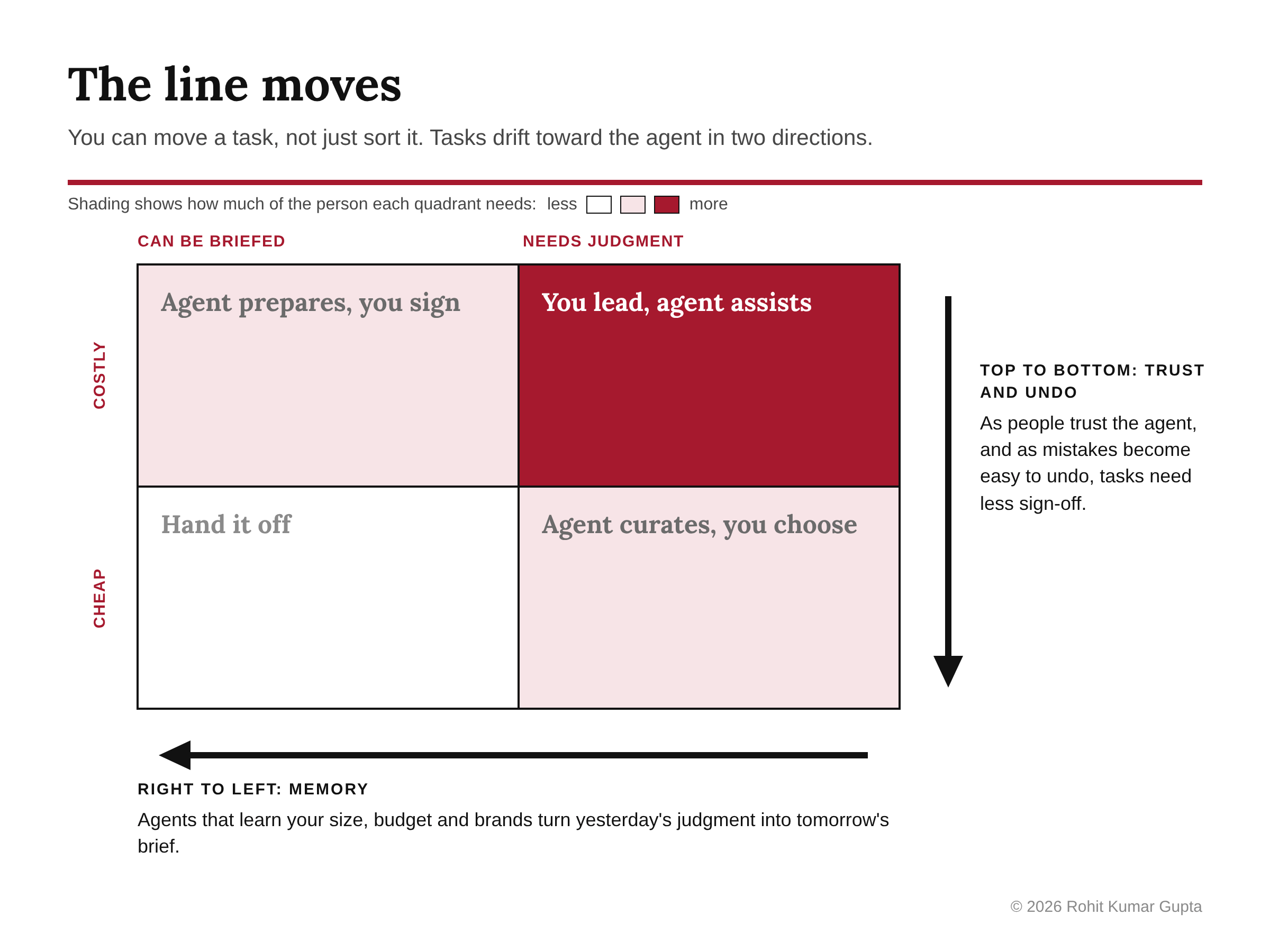
The second is that the line moves, and it moves in two directions. Personal agents that remember your size, your budget and your favorite brands will turn yesterday’s judgment into tomorrow’s brief, so tasks drift from the right of the matrix to the left. Castelo’s team found that simply describing a task as data-driven made people more willing to hand it to an algorithm. At the same time, as people come to trust an agent and as products make mistakes cheap to reverse, tasks drift from the top row to the bottom. A wrong call that can be undone in one tap costs less, so it needs less sign-off.
That second drift gives product leaders a lever as well as a map. You can move a task, not just sort it.
I think all of this makes the case for experience stronger. As agents absorb the routine, the moments left for people get fewer and higher-stakes. Each one deserves more design attention.
Hybrid by quadrant
PostHog has written the most thoughtful version of the middle view. It argues the future is hybrid rather than headless, and it tells product teams to drop the screens agents make redundant and to invest in approval, review and undo. I agree with most of that.
What is oversold is hybrid by default: a full agent path and a full human experience for every flow, as if the two share the work evenly. That is expensive, and it misses the shape of what is coming. My view is hybrid by quadrant. The agent leads, and the person comes in only where the matrix says their judgment or their sign-off is needed.
In a consumer product, the agent might filter a hundred hotels down to three, and the person picks the one that feels right. In an enterprise product, the agent codes the expense reports on its own, drafts the purchase approval for a manager to sign, builds the vendor shortlist for the team to choose from, and leaves the org design to the people who will live with it. The interface shrinks to the moments that matter, and those moments get much better.
What this means if you run a product
Run the Phronesis Test across your product, workflow by workflow, and fund each quadrant differently.
Make the bottom-left headless first. Expose clean data and actions so agents can finish these jobs without touching your screens, and give people a clear receipt of what was done. Watch what agents try to do. As PostHog puts it, when an agent reaches for something your product does not have, it is effectively telling you what to build next.
Invest in decision screens for the top-left. These are the approval, review and undo moments. Show exactly what changed instead of a summary of it. Then invest in undo itself, because every task you make easy to reverse can move down a row and take less of the person’s time.
Treat the bottom-right as your experience. This is where browsing, discovery and delight still earn their keep, and where the agent’s job is to narrow the field and leave the choice to the person.
Build real workspaces for the top-right. These are the decisions people will not hand over, and the agent’s role is research and options.
If most of your product sits on the right side of the matrix, staying experience-first can be a strategy in its own right. For brands whose value is the experience, going fully headless would turn them into a commodity. Even they should make the chores headless, though: reorders, order tracking, returns. Otherwise agents will route those jobs elsewhere, and some of the customer relationship will go with them.
Where this settles
The headless camp is right that agents will take over a large share of the work people do on screens. The experience camp is right that people will keep using interfaces. Both are describing the same thing from different ends.
Agents will take every job that can be briefed and trusted to them, and they will favor the products that make that easy. Experience will keep everything that needs judgment, and those moments will matter more as they become rarer. I think that is where this settles. The product leaders who do well will be the ones who know, task by task, which side of the line they are on, and how to move it.